Kaoshi
AI worksheet generator for teachers.
The breakthrough wasn't better AI—
it was fixing the iteration loop.
The Problem
Teachers spend hours creating worksheets. Not the fun part—planning lessons, engaging students—but the mechanical work of generating questions, formatting, adjusting difficulty.
When ChatGPT launched, teachers flocked to it. Finally, a way to automate the drudgery. But something interesting happened: they kept using it, but they kept complaining.
A typical ChatGPT session
2. Factor x² - 9...
"Too easy. Wrong difficulty distribution. Can't edit inline. Have to copy-paste everything and start over."
— Teacher's internal monologue
"ChatGPT gives me garbage, but at least I can edit it. The other AI worksheet tools give me garbage I can't fix."
This was the pattern: generate, review, copy-paste into Word, edit, format, repeat. The AI saved time on generation but created friction everywhere else.
The Constraint
Existing AI worksheet tools made the same mistake: they treated generation as a one-shot process.
But teaching is inherently iterative. A worksheet isn't "done" when the AI finishes generating—it's done when the teacher is satisfied.
The Bottleneck
Not generation speed. Iteration speed.
ChatGPT
- ✓ Can edit output
- ✓ Conversational iteration
- ✗ Loses formatting
- ✗ Copy-paste workflow
AI Worksheet Tools
- ✓ Purpose-built interface
- ✓ Keeps formatting
- ✗ Can't edit the plan
- ✗ One-shot generation
ChatGPT won not because it generated better content, but because it let teachers iterate conversationally. The cost was context loss—each prompt started fresh, formatting broke, mental models fragmented.
The Insight
Teachers don't want to write questions from scratch—that's what AI is for. But they do want to control the pedagogical structure.
The plan is where teacher expertise lives. Question types, difficulty distribution, cognitive levels.
Let teachers own the plan.
Let AI handle the composition.
The Two-Phase Pipeline
Planning Phase
AI generates a structured plan. Teacher reviews and edits.
Q2: Short answer, Medium, Application
Q3: Essay, Hard, Analysis
Composition Phase
AI generates each question. Teacher watches, pauses, edits.
Generating Q2... ✓
Generating Q3... ...
The Craft
Building the plan editor was the hardest part. It needed to feel as fluid as editing a document, but with structured data underneath.
Every interaction was optimized for speed of iteration.
Undo/Redo (50 states)
Teachers experiment freely knowing they can revert. State history persists across sessions.
AI Suggestions
The plan critiques itself: "Add more application-level questions" or "Balance difficulty better."
Drag & Drop
Questions flow better when sequenced intentionally. Reorder by difficulty, topic, or pedagogical arc.
Pause & Resume
Generation streams in real-time. Pause mid-stream to review, then resume or regenerate.
The "Make It Harder" Problem
When teachers ask ChatGPT for a harder question, they often get the same question with more complex vocabulary—not genuinely higher cognitive demand.
Original:
"What is the main idea?"
"What is the central thematic conceit?"
Same cognitive level. Just bigger words.
Kaoshi's Fix
Explicit difficulty parameters the AI can't fake:
- Bloom's taxonomy level
- Reasoning steps required
- Cognitive complexity factors
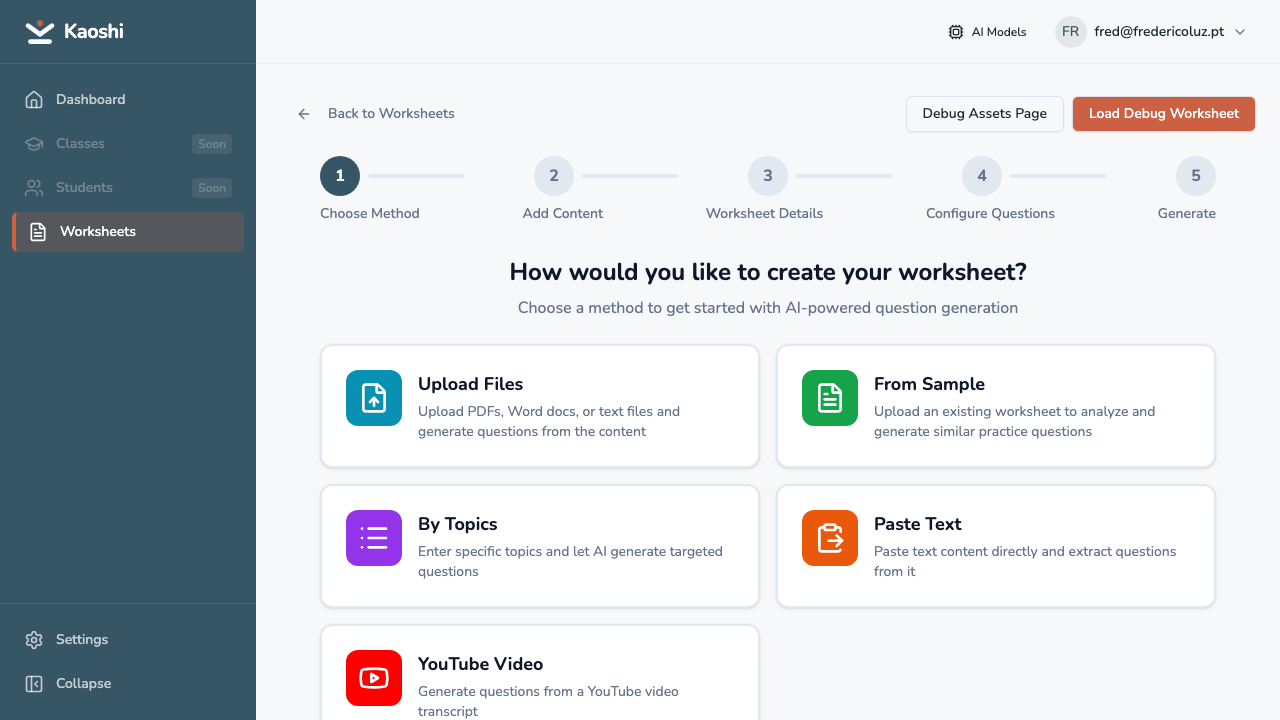
Five entry points, one consistent experience
Technical note: The LLM integration isn't special—Vercel AI SDK. The state management is where the work went. Client-side React hooks, localStorage persistence, optimistic UI. Reduced LLM abstraction from ~1,500 lines to ~200. But that's not the story.
The Lesson
Teachers don't want AI to replace their judgment. They want AI to accelerate their workflow while preserving their agency.
The best AI tools aren't the ones with the most advanced models. They're the ones that understand the human workflow and remove friction from the iteration loop.
Kaoshi's breakthrough wasn't Kimi-K2's 200K context window or Claude Haiku's speed. It was the realization that planning and composition are different cognitive modes—and building an interface that respects that difference.
Control beats automation.
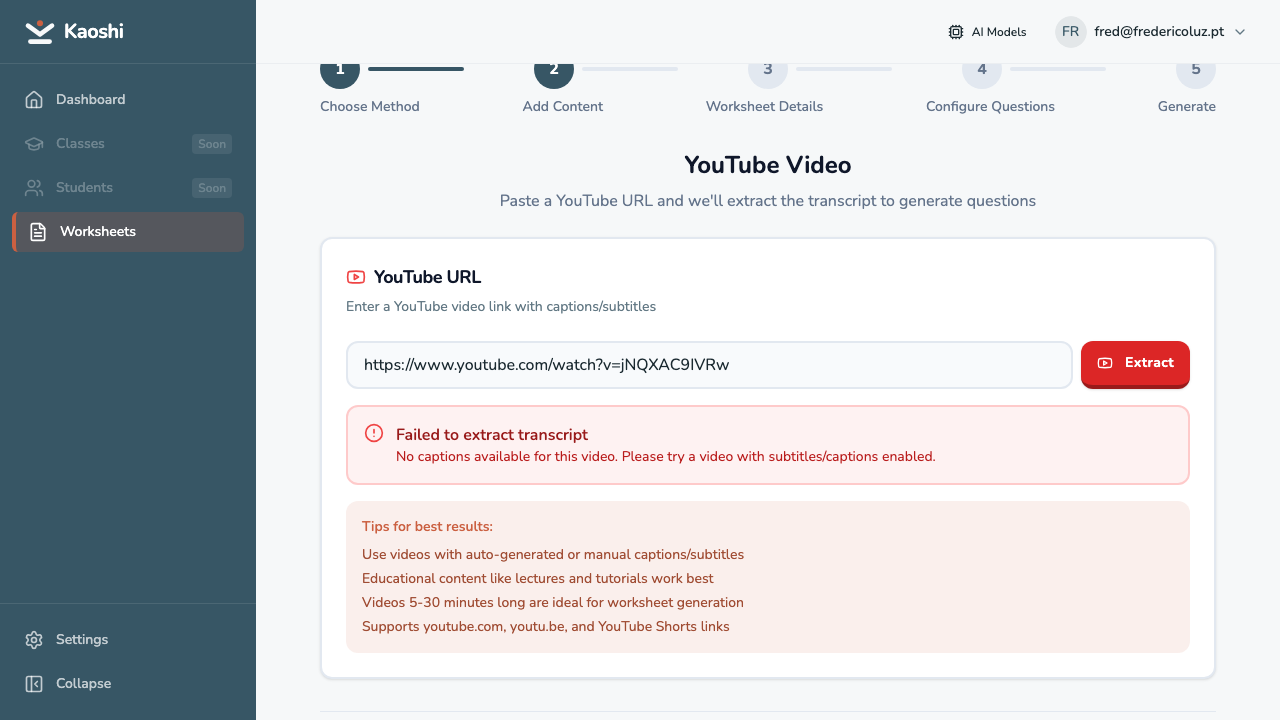
Questions appear one by one, editable at any time
Built with